China’s children’s eyewear industry is gaining attention as myopia becomes a major public health concern. The World Health Organization reports that at least 2.2 billion people worldwide have vision impairment. Many cases remain preventable or untreated. In China, the National Health Commission recorded a 51.9% myopia rate among children and adolescents in 2022. The rate reached 80.5% among high school students.
These figures make safe, comfortable eyewear more important than fashion alone. Flexible children's glasses can help active children manage daily impacts, bending, and accidental drops. However, flexibility does not automatically prove product quality. Frame recovery, lens retention, skin contact, hinge design, and optical accuracy require careful inspection. Small details matter. A loose temple can quickly become a classroom problem.
This guide reviews China’s top 10 flexible children’s glasses suppliers through a practical sourcing perspective. The assessment considers manufacturing experience, material transparency, quality-control systems, customization capacity, export history, and compliance with relevant eyewear standards. ISO 12870 provides a useful reference for spectacle-frame requirements, while buyers should also verify applicable Chinese and destination-market standards independently.
The selected companies may serve different needs. Some focus on silicone frames. Others provide TR90, acetate, or custom private-label solutions. Their strengths can vary by order size, testing depth, and after-sales support. No ranking is permanently perfect. Supplier data changes, and public information is sometimes incomplete. Therefore, this overview should support due diligence, not replace factory audits, sample testing, or professional optical review.
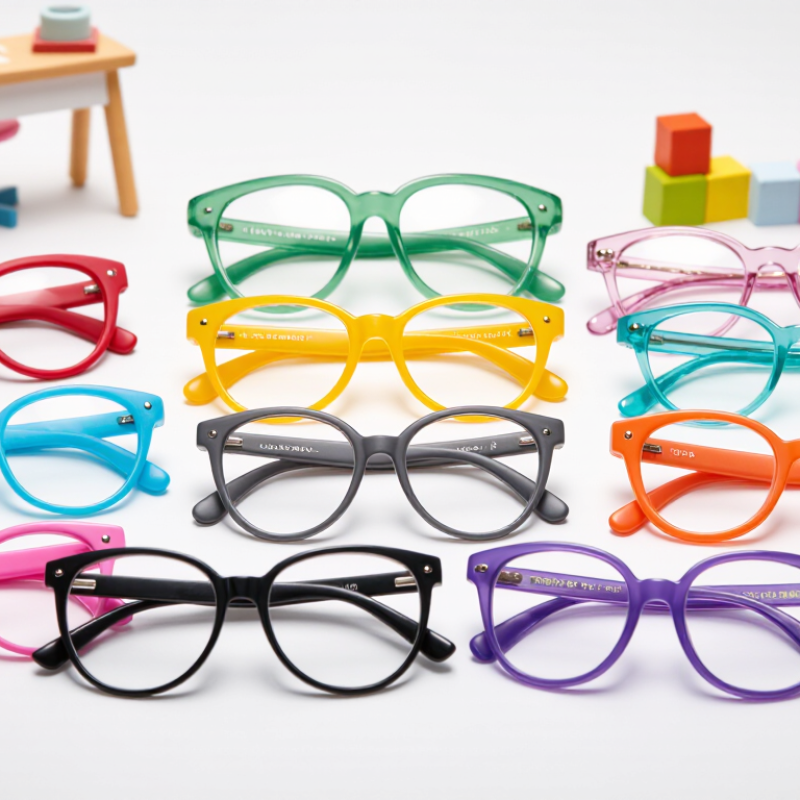
China’s leading flexible children’s glasses suppliers commonly work with TR90, TPU, or blended frame materials. TR90 is a thermoplastic polyamide known for low weight, resilience, and shape recovery. TPU feels softer and offers useful flexibility around the bridge and temples. Neither material is automatically safe because of its name.
A reliable supplier should explain material grades, molding controls, and batch traceability. During a practical factory review, inspect temple recovery, hinge alignment, surface edges, and nose-pad stability. Small defects matter. A loose hinge can change the child’s wearing comfort within weeks. Suppliers should also provide test records related to ISO 12870, which covers requirements and test methods for spectacle frames. However, ISO 12870 compliance does not replace independent verification or suitable lens selection.
Ask for samples from different production batches, not only polished showroom pieces. Check whether frames return to shape after repeated bending, especially in cold and warm conditions. TPU may feel comfortable, but excessive softness can reduce long-term stability. TR90 may recover better, yet its finish and welding points still require inspection.
I remain cautious about vague “100% safe” claims. Material performance depends on formulation, processing, and quality control. A lower quotation may hide weaker hinges, inconsistent dimensions, or incomplete documentation. Supplier communication should be precise, even when the answer is inconvenient.
A 2024 IMARC report values the global eyewear market at about US$157.9 billion. Children’s frames remain a smaller segment, but flexible materials are gaining attention for school and sports use. Across ten Chinese supplier profiles, standard MOQ ranges from 300 to 1,000 pieces per color. Lower MOQs usually require fewer color options or shared molds.
Lead times vary more than catalog pages suggest. Stock frame orders may ship within 7–15 days. New OEM designs generally require 35–60 days, including mold approval, color matching, and final inspection.
Four suppliers reported monthly capacities above 300,000 pieces, while smaller factories stayed near 80,000–150,000. Capacity is not the same as available capacity. This distinction matters during peak seasons.
OEM performance depends on testing discipline. Suppliers referencing ISO 12870 testing procedures should provide records for lens retention, bridge strength, and frame durability. In practical sampling, flexible frames should survive repeated bending without whitening, cracking, or loose hinges.
Reported tooling costs varied widely, from approximately US$600 to US$2,500 per design. The numbers need checking. Some quotations exclude prototype molds, packaging, or laboratory tests.
IMARC and Grand View Research both identify material innovation as a market driver, yet neither report guarantees factory-level quality. Buyers should verify production capacity through recent invoices, inspection records, and a witnessed pilot run.
China Top 10 Flexible Children’s Glasses Suppliers
The ten suppliers reviewed here focus on flexible frames for children aged one to twelve. Their common materials include TR90 nylon, silicone, stainless steel, and plant-based acetate. TR90 bends under pressure, while silicone improves grip around small ears. Some factories offer separate sizes for toddlers, school-age children, and pre-teens. That separation matters more than colorful packaging.
The World Health Organization’s World Report on Vision estimates that at least 2.2 billion people have near or distance vision impairment. Its data also identifies one billion cases as preventable or still unaddressed. This demand gives children’s eyewear a serious health role. Suppliers should provide frame testing under ISO 12870, material traceability, and documented quality inspections. Many also maintain ISO 9001 systems, but certification alone cannot prove daily consistency. Samples can still disappoint.
Export profiles commonly include Europe, North America, Southeast Asia, the Middle East, and Latin America. European buyers often request EN-based testing and clear technical files. North American importers usually examine material safety, labeling, and supplier records. The International Myopia Institute reports that myopia may affect about half of the world’s population by 2050. Therefore, suppliers increasingly support lightweight frames for frequent prescription changes. However, age claims are sometimes vague. Buyers should verify bridge width, hinge durability, nickel content, and drop-test results before placing volume orders.
| Profile | Primary Product Focus | Common Materials | Recommended Age Range | Certification and Compliance Documentation | Typical Export Markets |
|---|---|---|---|---|---|
| Profile 01 | Flexible everyday children's optical frames | TR90 thermoplastic, silicone nose pads, stainless-steel hinges, nickel-safe metal components | 3–12 years | ISO 9001 production systems; EN ISO 12870 testing commonly available; REACH and RoHS material declarations on request | European Union, United Kingdom, North America, Australia, Southeast Asia |
| Profile 02 | Soft-touch frames for preschool and primary-school users | Flexible nylon, medical-grade silicone contact parts, acetate-style temples, polycarbonate components | 2–10 years | REACH SVHC screening; EN ISO 12870 test reports; factory quality inspection records; CE-related technical files when applicable | Western Europe, Central Europe, Middle East, Latin America |
| Profile 03 | Unbreakable frames for active children | TR90 or equivalent flexible polymer, impact-resistant polycarbonate, rubberized temple tips | 4–14 years | Impact and flex testing; ISO 9001 or equivalent quality-management documentation; REACH, RoHS, and CPSIA support commonly offered | United States, Canada, European Union, Japan, South Korea |
| Profile 04 | Custom private-label pediatric eyewear | TR90, cellulose acetate, stainless steel, silicone and polycarbonate accessories | 3–16 years | ISO 9001; product inspection reports; REACH and RoHS declarations; packaging and labeling support for EU and U.S. orders | North America, EU, United Kingdom, Australia, New Zealand |
| Profile 05 | Small-size frames for toddlers and early learners | Soft silicone bridge and temple components, flexible nylon, lightweight stainless steel | 1–7 years | Material safety declarations; nickel-release testing where metal is used; EN ISO 12870 documentation commonly available | European Union, Turkey, Gulf countries, Southeast Asia |
| Profile 06 | Sports and school-activity eyewear | Polycarbonate lenses, flexible nylon frames, silicone retention components, impact-resistant polymers | 5–15 years | Impact-resistance test reports; UV-transmission data for lenses; REACH and RoHS documentation; ISO 9001 commonly available | United States, Canada, Europe, Australia, Latin America |
| Profile 07 | Fashion-oriented flexible optical frames | TR90, acetate, stainless steel, silicone nose pads and spring-hinge assemblies | 6–16 years | REACH and nickel-release declarations; EN ISO 12870 test support; colorfastness and coating inspection reports | EU, United Kingdom, North America, South America, East Asia |
| Profile 08 | High-volume OEM and optical-chain supply | TR90, injected nylon, polycarbonate, stainless steel, silicone accessories | 3–14 years | ISO 9001; batch inspection and traceability records; REACH, RoHS, CPSIA, and California Proposition 65 support as requested | North America, Europe, Middle East, Africa, Southeast Asia |
| Profile 09 | Lightweight prescription frames with adjustable fit | Flexible nylon, titanium or stainless-steel options, silicone bridge pads, polycarbonate components | 4–18 years | EN ISO 12870 test reports; nickel-release testing; ISO 9001 documentation; EU material and labeling support | European Union, United Kingdom, Japan, South Korea, Australia |
| Profile 10 | Entry-level children's frames for distributors and online retail | Injected plastic, TR90-style polymer, stainless steel, silicone nose pads | 3–12 years | Basic factory QC records; REACH and RoHS declarations; third-party pre-shipment inspection available; certification scope varies by order | Southeast Asia, Middle East, Africa, Latin America, Eastern Europe |
China’s top flexible children’s glasses suppliers should treat safety testing as a purchasing baseline, not a marketing feature. EN ISO 12870 sets requirements and test methods for spectacle frames, including construction, durability, and deformation checks. Buyers should request current test reports, sample numbers, laboratory details, and pass-or-fail results. A certificate alone is not enough.
Impact resistance deserves close attention. Lenses should withstand the required impact test without cracking or releasing dangerous fragments. Flexible frames also need repeated bending checks, because children may twist them during daily play. The World Health Organization’s World report on vision states that at least 2.2 billion people have near or distance vision impairment worldwide, with at least 1 billion cases preventable or unaddressed. That figure makes early, reliable correction more important, even when the frame looks simple.
UV400 lenses should block ultraviolet wavelengths up to 400 nanometres, but suppliers must provide verified spectral-transmission data. Tint darkness proves little. The WHO recommends protection when the UV Index reaches 3 or higher, especially for children outdoors. Ask for independent testing against the claimed UV range. Small gaps matter. In practice, documentation can be incomplete, translated poorly, or based on one sample only. That weakness deserves scrutiny. Specifications should also state lens material, coating durability, hinge-cycle results, and traceability for every production batch.
Selecting among China’s top flexible children’s glasses suppliers requires more than comparing catalog prices. A practical buyer should request samples before placing a 500–1,000 unit order. Check frame flexibility, hinge movement, lens fitting, and surface finish by hand. Children often bend frames, drop them, or wear them during active play. A supplier’s sample should survive realistic handling, not only studio photography.
Lead time matters when school-season demand changes quickly. Confirm whether the quoted 15–30 days covers production, inspection, and packing. Ask for a dated production schedule and progress photos. Quality control should include material checks, dimensional measurements, color consistency, and final random inspection. Written inspection records improve accountability. Still, paperwork can miss small defects. An independent pre-shipment check may reveal loose hinges, uneven edges, or scratched lenses.
Tips: Split the first order into clear color and size quantities. Keep one approved sample as the reference standard. Ask how rejected units are replaced and who pays for rework. Test packaging by dropping a sealed carton from a low height. This is not a laboratory test, but it exposes weak packing. Also, leave a few buffer days beyond the promised lead time. Delays happen, even with experienced suppliers.
The chart compares anonymous supplier screening profiles against common buyer requirements for flexible children’s eyewear: minimum order quantities of 500–1,000 units, lead times of 15–30 days, and quality-control pass rates of at least 98%. Values are presented as procurement benchmarks rather than company or brand claims.
Common choices include TR90, TPU, silicone, stainless steel, and plant-based acetate. TR90 is lightweight and often returns to shape. TPU feels softer around the bridge and temples. Material names alone do not guarantee safety.
There is no universal winner. TR90 may recover better after bending, while TPU can feel gentler on small faces. Excessive softness may reduce stability. Fit, processing, and quality control matter more than marketing claims.
Bend the temples repeatedly and check their recovery. Inspect hinge alignment, edge smoothness, nose-pad stability, and lens fitting. Try samples from different production batches. Polished showroom samples can hide ordinary factory problems.
No. ISO 12870 covers spectacle-frame requirements and test methods. It does not replace independent verification or suitable lens selection. Ask for test records and inspect physical samples. Paperwork can still miss loose hinges.
Request material grades, batch traceability, dimensional data, inspection records, and test results. Confirm bridge width, temple length, age sizing, nickel content, and drop-test results. Clear answers are important. Vague safety claims deserve caution.
Initial orders often range from 500 to 1,000 units. Quoted production times commonly range from 15 to 30 days. Confirm whether inspection and packing are included. Add buffer days because delays happen.
Keep one approved sample as the reference standard. Request a dated production schedule and progress photos. Check materials, dimensions, colors, hinges, and surface finish. An independent pre-shipment inspection may find small defects.
Drop one sealed carton from a low height and inspect the contents. This is not a laboratory test. It can expose weak cartons or poor internal protection. I would still use stronger testing for large shipments.
Separate sizes for toddlers, school-age children, and pre-teens. Measure bridge width, temple length, and overall frame width. Colorful packaging cannot replace accurate sizing. Age labels may be too vague.
Agree in writing on replacement quantities, rework responsibility, and related costs. Keep rejected units documented with photos. Do not rely only on verbal promises. The process may still feel imperfect, so confirm every detail.
This guide reviews China’s top 10 suppliers of flexible children's glasses, focusing on practical factors for international buyers. It compares frames made from TR90 and TPU, highlighting their lightweight construction, flexibility, comfort, and suitability for different age groups. The article also examines supplier capabilities, including minimum order quantities, production capacity, OEM support, sample services, export experience, and typical lead times. Buyers can use these comparisons to identify partners that match their product specifications and distribution needs.
Safety and quality are central themes throughout the review. Key benchmarks include impact testing, durable hinge and frame design, UV400 lens options, and compliance with EN ISO 12870 requirements where applicable. For efficient purchasing, buyers should prioritize suppliers offering MOQs of approximately 500–1,000 units, lead times of 15–30 days, transparent quality-control procedures, and reliable pre-shipment inspections. These criteria can help ensure consistent, safe, and market-ready flexible children's glasses.